
Abirlal Gangopadhyay

Echoes of Healing Sound
A gentle wanderer through Sanskrit’s ancient groves, where forgotten svaras whisper remedies to weary souls. In Barasat’s quiet lanes, he listens to Vedic strings, weaving threads from ritual fire to modern healing. His path is patient reconstruction: melodies that steadied kings in exile, reborn as bridges between rasa and sattva.
The Seed of Sanskrit
At fourteen, beside the sacred Ganga at Ramakrishna Math Vivekananda Veda Vidyalaya in Belur, he tasted Sanskrit grammar and Vedic chants, planting roots of lifelong adherence to the ancients’ language.
Deepening in Pursuit
His PhD at the University of Hyderabad (2023) yielded a thesis on rasa in non-lyrical pure music, earning the Rai Narhari Pershad Medal (2024) and founding his SRD framework.
Blossoming in the Halls
Through B.A. Honours (2016) at Ramakrishna Mission Vivekananda Educational and Research Institute and M.A. (2018) at Jadavpur University, he deepened his immersion in musicology and aesthetics.
Ripening in Reflection
Now independent, he reconstructs Vedic-Ayurvedic music therapy through publications on Aśvamedha gāthās and sattva-mediated healing, pausing with empty chai cups where steam fades like an ancient rite into insight.
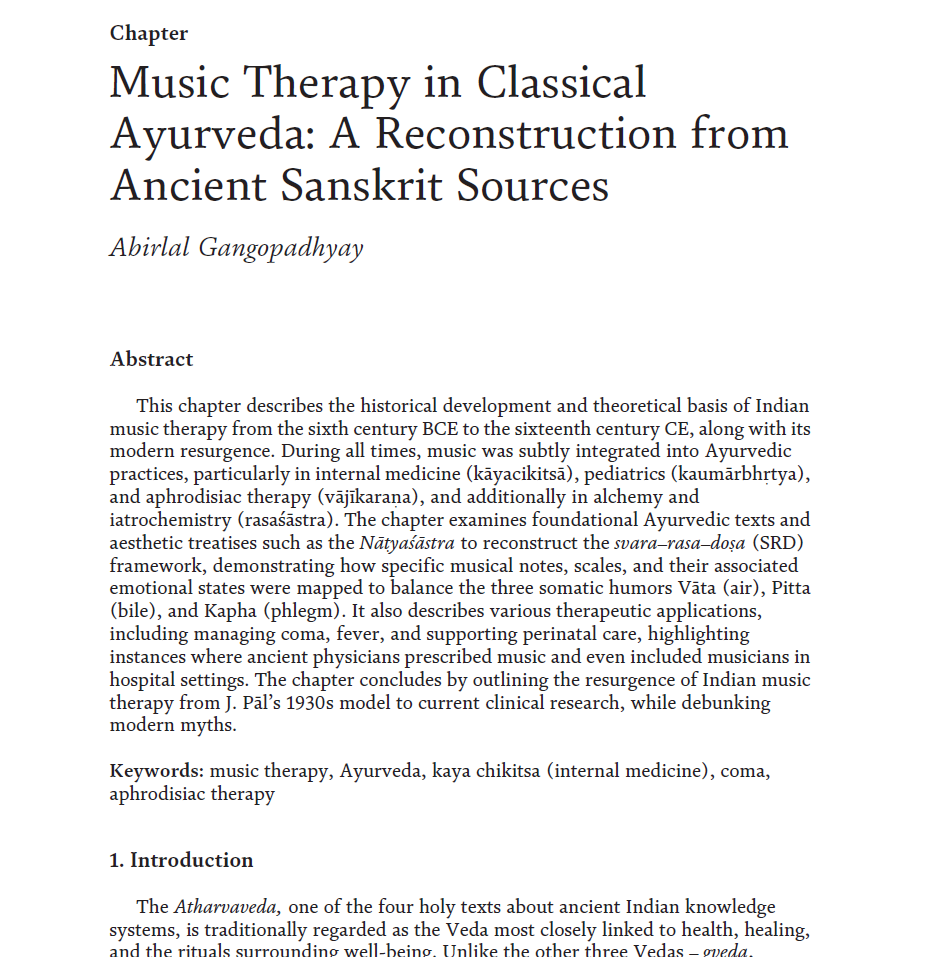
Gangopadhyay’s open-access chapter, Music Therapy in Classical Ayurveda: A Reconstruction from Ancient Sanskrit Sources, meticulously traces the historical integration of music as a therapeutic tool in Ayurveda from the 6th century BCE to the 16th century CE. Drawing from foundational texts like the Caraka Saṃhitā, Suśruta Saṃhitā, Aṣṭāṅga Hṛdaya, Kaśyapa Saṃhitā, and aesthetic treatises such as the Nāṭyaśāstra, the work reconstructs the innovative svara–rasa–doṣa (SRD) framework. This model maps musical notes (svara) to emotional states (rasa) and the three bodily humors (doṣa: Vāta, Pitta, Kapha), applying principles like “opposites balance” to modulate consciousness, elevate sattva (clarity and harmony), and restore physiological equilibrium.
The chapter highlights music’s subtle yet pervasive role in internal medicine (kāyacikitsā), pediatrics (kaumārbhṛtya), aphrodisiac therapy (vājīkaraṇa), and even alchemy (rasaśāstra). Specific applications include using soothing vīṇā melodies or songs for reviving patients from coma, Karuṇa rasa-infused notes to pacify aggravated Pitta in fever and hyperpyrexia, sāttvic gīta and vāditra for perinatal care and newborn stabilization, and therapeutic sounds to aid digestion, manage tuberculosis, alleviate mental distress, and support post-purgation recovery. Ancient physicians even recommended employing musicians in hospital settings.
The analysis debunks modern myths while noting a post-16th-century lull until the 1930s resurgence (e.g., J. Pāl’s influential work). Published online first by IntechOpen on February 4, 2026, this peer-reviewed chapter offers a scholarly bridge between ancient wisdom and contemporary interdisciplinary interest in sound-based healing.
Click the image on the left side to read or download the full open-access chapter directly.